



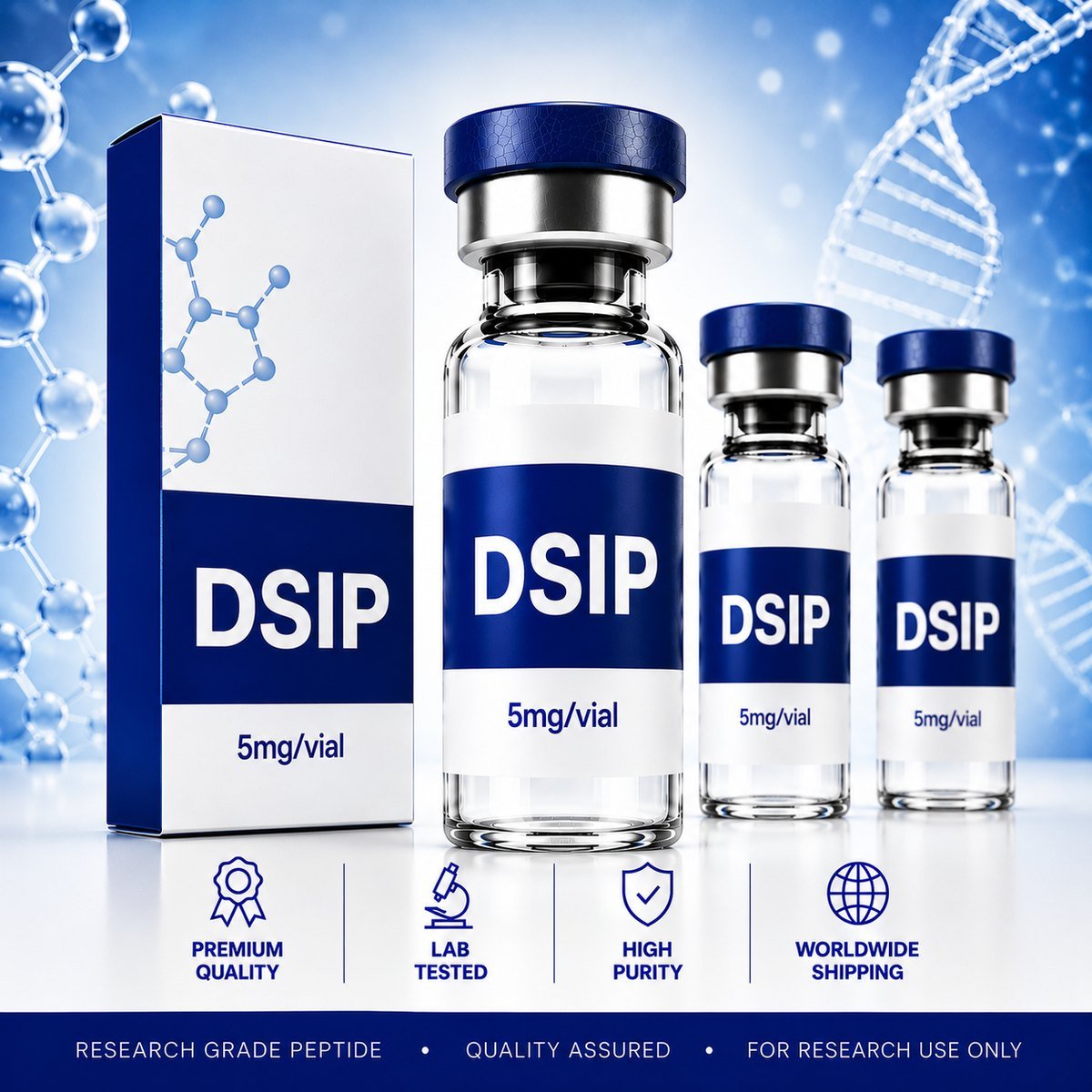
DSIP
请选择规格
$122.00 – $210.00Price range: $122.00 through $210.00
* The information on this page is a summary and is not intended to cover all available information about this medication. It does not cover all possible uses, directions, precautions, drug interactions or adverse effects and is not a substitute for the expertise and judgement of your healthcare professional.
Introduction
This particular short peptide has been in the focus of neurochemistry labs longer than most. Discovered through studies of cerebral activity associated with sleep, it has since found its way back to the limelight in research projects involving the study of the regulation of endogenous signaling pathways. Please note that the information provided is intended solely for use by qualified scientists for reference purposes. None of the information provided should be considered as a recommendation of any sort for human or animal use – this product is intended solely for laboratory research.
At all times, focus is on literature information, analytical characterization of the substance, and reasons for the importance of purity documentation.
DSIP
The delta sleep-inducing peptide is a nonapeptide, meaning its backbone comprises nine amino acid residues. Its canonical sequence is Trp-Ala-Gly-Gly-Asp-Ala-Ser-Gly-Glu, and it carries no disulphide bridges or unusual post-translational modifications in its native form. Because the structure is comparatively simple, it lends itself well to solid-phase synthesis and to the analytical methods used to confirm identity.
Naming, incidentally, reflects the context of its discovery rather than a defined pharmacological role. That distinction is worth holding onto: the peptide’s designation points to an observed correlation in early animal work, not a settled mechanism. Contemporary research tends to treat it as a modulatory molecule of interest rather than a factor with one fixed function.
How It Is Studied
These compounds are generally studied through in vitro analyses and animal models in which endpoints may be measured free of the interfering factors found in more complex systems. Examples of common research protocols include analysis of receptor binding properties, biochemical effects, and electrophysiology of neural tissue samples.
A second line of study is related to the stability of the peptide in terms of its sensitivity to different pH levels, temperatures, and buffers. The properties of a molecule determine the procedures that must be employed in the handling of the compound; analytical chemists find this peptide ideal as a test compound in the development of procedures.
A third area of research is reconstitution studies. Information about solubility in various solvents allows laboratories to establish reliable preparations.
Scientific Characteristics
Several molecular features make this nonapeptide a convenient subject for benchtop investigation:
- Modest molecular weight. Being approximately 848 daltons in weight, this peptide easily fits into the window of molecules that can be identified with high resolution mass spectrometry.
- Hydrophilic tendency. Presence of acidic and hydroxyl-containing amino acids means that the molecule possesses adequate aqueous solubility.
- Absence of cysteine. It lacks thiol groups, so it does not have to be concerned about oxidation and subsequent dimerization.
- Sensitivity to enzymatic cleavage. As is the case with most linear peptides, it is prone to peptidase action; hence the need for special storage conditions.
These are merely some physical aspects of the compound, and by no means should they determine its biological role.
Current Research Areas
The scientific interest in this sequence includes several interrelated areas. The neurochemical signaling pathway is one of the most extensively studied ones; although numerous articles have described its effects on the regulation mechanisms in the central nervous system, this area is still under debate, and no definite conclusions have been made yet.
However, apart from this, there is a body of exploratory works focusing on the role of the oxidative-stress biomarkers and cell resistance. The connection of the peptide with the endocrine feedback loop has also been investigated by studying whether this sequence corresponds to changes in the concentrations of some signaling agents. The peptide has been used in comparative studies in which it is only one of the several short peptides for verification of experimental or computational analysis.
It should be noted that all the above-mentioned researches are preliminary in their nature. Most of the existing data comes from small sample and animal studies; therefore, any attempt to generalize the results would be inappropriate. Thus, the peptide can be considered an unsolved problem.
Research Quality & Testing
Good results come from good materials, and here the role of documentation is justified. All batches provided for experiments in the lab must be documented as having been confirmed as pure and identified through independent testing.
There are two analytical tools behind this confirmation process. Reversed-phase HPLC tests for purity through the separation of the desired peptide from synthesis-associated impurities, shortened sequences, and leftover chemicals; usually, the high-purity peptide shows a clear peak without shoulders. The next step – LC-MS – proves that the peptide’s molecular weight matches the calculated value for the nine-amino-acid sequence, ensuring the identity is proven.
The result of all this analysis is the batch-specific Certificate of Analysis. COA holds information on the purity percentage, the methods used in the process, and the lot number that links the certificate to the specific physical batch of peptides. Such documentation chain is a necessary step for any lab that wants to verify its results, not just a formal procedure. An honest UK peptide provider will make sure you get all the documents.
Such purification analysis also shields one from the risk of variability between batches. Where a research peptide undergoes consistent HPLC testing and LC-MS verification, any comparison between experiments can be considered accurate rather than mere conjecture.
Laboratory Storage
How it is handled determines the shelf life of a peptide under investigation. Peptide in lyophilized form is normally the most stable at low temperature and away from light and moisture; some labs keep their peptide stored in frozen vials in the absence of light and moisture. Upon reconstitution, its stability will reduce, therefore, making smaller quantities of aliquot ideal to avoid several freeze-thawing processes.
Desiccation is an important aspect in handling peptides. Due to the nature of the amino acids in a peptide, it will attract moisture easily and cause clumping and hydrolysis. It is therefore wise to keep a sample dry along with proper documentation of when the sample was made in order for the user to know the history of the sample.
Conclusion
What makes delta sleep inducing peptide an enduring subject of study is not that there has been enough study done to explain what its function is, but rather that there is not enough study. The small molecular nature of the compound, along with the relative simplicity of the analysis and the mysteries left unsolved about its biochemistry make it a worthwhile subject for investigation within multiple lab fields. In the lab, the merit of a substance lies less in conjecture and more in methodology; proper synthesis, independent HPLC validation, LC-MS verification and clear certificate of analysis create an interesting substance into an experimentable one.
Frequently asked questions
A seemingly elegant design can quickly begin to bloat with unexpected content or break under the weight of actual activity. Fake data can ensure a nice looking layout but it doesn’t reflect what a living, breathing application must endure. Real data does.
Websites in professional use templating systems. Commercial publishing platforms and content management systems ensure that you can show different text, different data using the same template. When it’s about controlling hundreds of articles, product pages for web shops.
A seemingly elegant design can quickly begin to bloat with unexpected content or break under the weight of actual activity. Fake data can ensure a nice looking layout but it doesn’t reflect what a living, breathing application must endure. Real data does.
Websites in professional use templating systems. Commercial publishing platforms and content management systems ensure that you can show different text, different data using the same template. When it’s about controlling hundreds of articles, product pages for web shops.
Reviews
Clear filtersThere are no reviews yet.